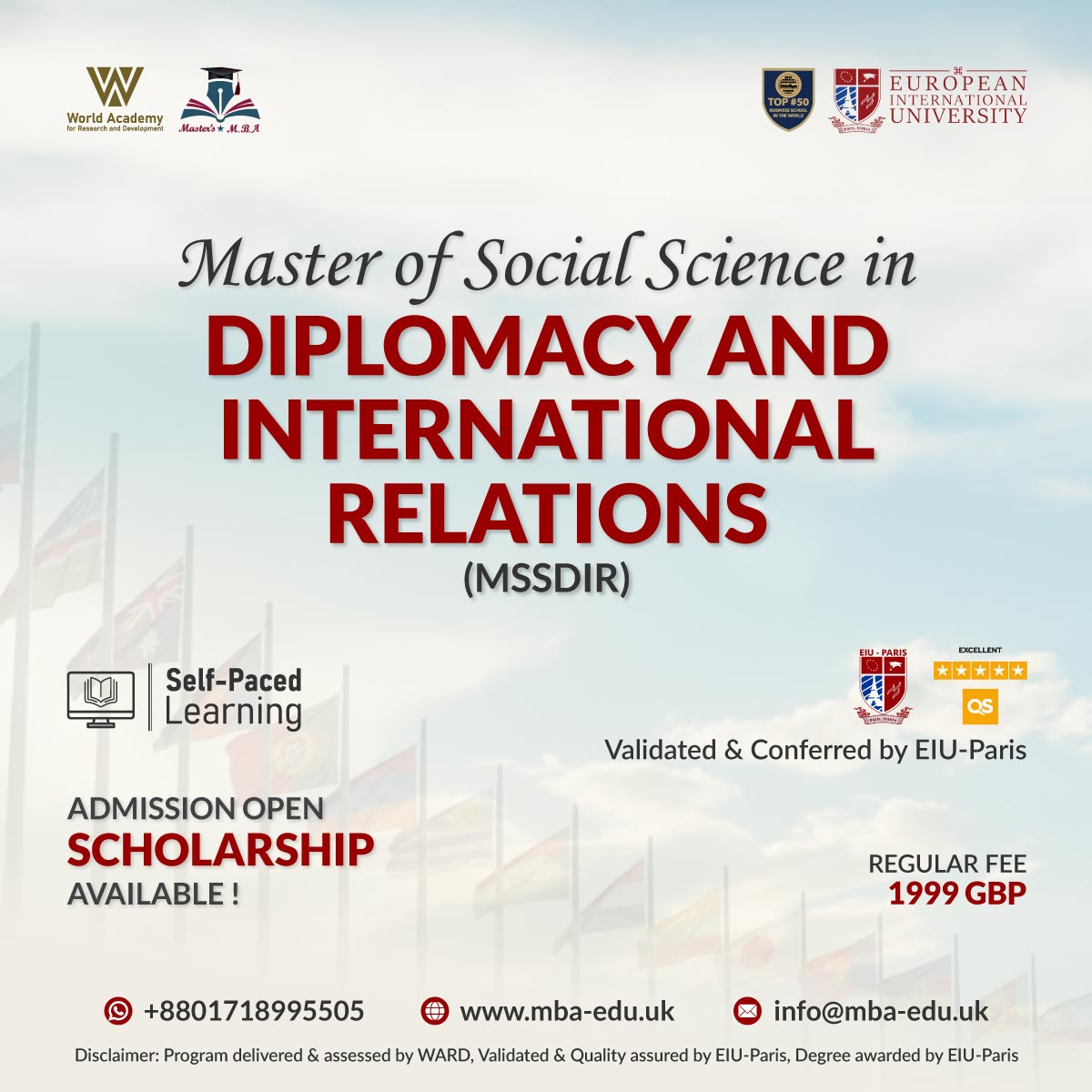
Master of Social Science in Diplomacy and International Relations (MSSDIR)

Validated, Quality Assured And Degree Awarded By EIU-PARIS

Everything You Need To Know

The Master of Social Science in Diplomacy and International Relations (MSSDIR) is an advanced, interdisciplinary programme designed to equip students with the critical knowledge and practical skills needed to navigate the complex landscape of global affairs. This program provides a comprehensive examination of the core principles, theories, and practices that underpin diplomatic engagement, international conflict, political economy, and global governance.

Structured around contemporary geopolitical challenges, the curriculum integrates rigorous theoretical analysis with applied, real-world problem-solving. Students will engage with critical issues such as international security, peacebuilding, human rights, global development, and economic justice. The program emphasizes evidence-based research, ethical reasoning, and the formulation of strategic policy responses.

Graduates will be prepared for impactful careers in foreign services, international organizations, non-governmental organizations, global think tanks, multinational corporations, and academic research, contributing to more peaceful, just, and cooperative international relations.

Objectives

    By the end of this programme, students will be able to:

    1. Analyze the historical evolution, core principles, and modern practices of diplomacy in bilateral and multilateral settings.

    2. Critically evaluate major International Relations theories (e.g., Realism, Liberalism, Constructivism) and apply them to contemporary global events.

    3. Diagnose the root causes of international and intrastate conflict and design comprehensive strategies for sustainable peacebuilding and post-conflict reconstruction.

    4. Compare and contrast political systems, institutions, and governance models across different regions and cultures.

    5. Assess the structures and dynamics of the global political economy, including trade, finance, development, and the role of multinational corporations.

    6. Evaluate the international human rights framework and mechanisms for global justice, including international courts and tribunals.

    7. Formulate and critique policies and approaches to international development, focusing on poverty reduction, sustainability, and good governance.

    8. Design and conduct independent, ethical research in International Relations using appropriate qualitative and quantitative methodologies.

    9. Synthesize knowledge from across the curriculum to produce an original, in-depth Action Research Paper on a salient issue in diplomacy or international relations.

    10. Develop the professional competencies required for effective practice as a diplomat, policy analyst, international advocate, or researcher in the global arena.

Eligibility & Entry Requirements

    Entry Requirements:

    • Recognized Bachelor Degree in any field or Recognized Post Graduate Diploma (PGD) 
    • Sufficient English language proficiency.
    • At least 1 year of working experience.
    • Participants must have the facility of smart phone or laptop or computer to maintain the program activity.
       

    Mature Entry Route (done on case-by-case evaluation basis only):

    • Candidates without any prior tertiary education and qualification should possess at least 10 years of professional working experience in the field of Business, Management, or related areas of work.
    • Candidates  who have completed HND Level 4 (Diploma) should possess at least 7 years of professional working experience in the field of Business, Management, or related areas of work.
    • Candidates who have completed HND Level 5 (Higher Diploma) should possess at least 4 years of professional working experience in the field of Business, Management, or related areas of working experience.

Course Modules

M-412: Introduction to Diplomacy [9 ECTS]

Introduction:
This foundational module explores the art and practice of diplomacy as the primary instrument of international relations. It examines the historical evolution of diplomacy from its classical forms to modern digital and public diplomacy. Students will analyze the functions of diplomatic agents, the structure of foreign ministries and embassies, and the processes of negotiation, communication, and representation in both bilateral and multilateral contexts.

Objectives:

  1. Trace the historical development of diplomacy from ancient times to the contemporary era.

  2. Understand the legal status, functions, and privileges of diplomatic agents and missions.

  3. Analyze the core processes of diplomatic negotiation, mediation, and crisis communication.

  4. Evaluate the role and challenges of multilateral diplomacy in international organizations.

  5. Assess the impact of digital technology and public opinion on modern diplomatic practice.

M-413: International Relations Theory [9 ECTS]

Introduction:
This module provides a comprehensive survey of the major theoretical paradigms that explain state behavior and the structure of the international system. It critically engages with Realism, Liberalism, Constructivism, Marxism, and feminist approaches, among others. Students will learn to apply these theoretical lenses to analyze historical events and contemporary global issues, developing a nuanced understanding of power, anarchy, cooperation, identity, and norms in world politics.

Objectives:

  1. Identify and compare the core assumptions and propositions of major IR theories.

  2. Apply theoretical frameworks to explain state behavior, conflict, and cooperation.

  3. Critically evaluate the strengths and limitations of different theoretical approaches.

  4. Analyze how norms, ideas, and identities shape international outcomes.

  5. Synthesize theoretical insights to construct coherent analytical arguments about global affairs.

M-414: International Conflict and Peacebuilding [9 ECTS]

Introduction:
This module investigates the causes, dynamics, and resolution of international and intrastate conflicts. It moves from theories of conflict onset and escalation to the practical tools of conflict management, including mediation, peacekeeping, and arbitration. A significant focus is placed on post-conflict peacebuilding, examining strategies for reconciliation, security sector reform, transitional justice, and sustainable institutional development to prevent relapse into violence.

Objectives:

  1. Diagnose the root causes and different phases of contemporary armed conflicts.

  2. Evaluate the effectiveness of third-party interventions, including mediation and UN peace operations.

  3. Design comprehensive post-conflict peacebuilding and state-building strategies.

  4. Analyze the roles of transitional justice mechanisms and reconciliation processes.

  5. Assess the challenges of building sustainable peace in fragmented societies.

M-415: Comparative Politics [9 ECTS]

Introduction:
This module provides the analytical tools to systematically compare political systems, institutions, and processes across different countries and regions. It examines varieties of regimes (democratic and authoritarian), electoral systems, executive-legislative relations, party systems, and the role of civil society. The course emphasizes understanding how different political structures shape policy outcomes, stability, and development.

Objectives:

  1. Apply the methodological framework of comparative political analysis.

  2. Compare and contrast different regime types and their institutional configurations.

  3. Analyze the impact of electoral systems and party dynamics on political representation.

  4. Evaluate the relationship between political institutions, governance, and economic development.

  5. Examine the causes and consequences of democratization and democratic backsliding.

M-416: International Political Economy [9 ECTS]

Introduction:
This module explores the interplay between politics and economics in the global arena. It analyzes the structures and actors that govern the world economy, including trade regimes, international financial institutions, multinational corporations, and states. Key topics include theories of IPE, globalization, development finance, economic sanctions, and the politics of trade wars and economic inequality.

Objectives:

  1. Critically assess the main theoretical perspectives in International Political Economy (IPE).

  2. Analyze the rules, institutions, and power dynamics of the global trade and financial systems.

  3. Evaluate the political motivations and consequences of economic statecraft (e.g., sanctions).

  4. Examine the role of multinational corporations and non-state actors in the global economy.

  5. Investigate the relationship between globalization, inequality, and domestic politics.

M-417: Human Rights and International Justice [9 ECTS]

Introduction:
This module examines the international human rights framework and the evolving system of global justice. It covers the development of international human rights law, key treaties and declarations, and the mechanisms for protection and enforcement. The module also investigates international criminal law, the role of tribunals (ICC, ICJ, ad hoc courts), and contemporary debates on humanitarian intervention, accountability, and universal jurisdiction.

Objectives:

  1. Map the historical development and legal foundations of the international human rights regime.

  2. Analyze the functions and effectiveness of UN and regional human rights bodies.

  3. Evaluate the principles and operational challenges of international criminal justice.

  4. Critically debate the tensions between state sovereignty and the responsibility to protect (R2P).

  5. Assess contemporary challenges to human rights, including in contexts of terrorism and new technologies.

M-418: International Development [9 ECTS]

Introduction:
This module critically engages with the theories, policies, and practices of international development. It explores the historical trajectory of development thought, from modernization to dependency and sustainable development. Students will analyze key issues such as poverty, aid architecture, debt, the role of NGOs, the Sustainable Development Goals (SDGs), and the critique of mainstream development paradigms.

Objectives:

  1. Trace the evolution of major theories and paradigms in development studies.

  2. Evaluate the structure, effectiveness, and politics of international aid and development finance.

  3. Analyze the central challenges of poverty, inequality, and sustainable development.

  4. Critically assess the roles and accountability of key actors (states, multilateral agencies, NGOs).

  5. Design a coherent development policy framework addressing a specific global challenge.

M-419: Research Methods in International Relations [9 ECTS]

Introduction:
This module provides the essential methodological toolkit for conducting rigorous research in International Relations and Diplomacy. It covers both qualitative (case studies, process-tracing, discourse analysis) and quantitative (basic statistics, data interpretation) methods. Emphasis is placed on research design, ethical considerations, sourcing reliable data, and crafting a compelling research proposal as a direct precursor to the Action Research Paper.

Objectives:

  1. Formulate clear, feasible, and significant research questions in IR.

  2. Design a robust and ethical research methodology appropriate to the research question.

  3. Apply key qualitative and/or quantitative data collection and analysis techniques.

  4. Critically evaluate scholarly literature and primary sources.

  5. Produce a detailed and academically sound research proposal.

M-420: Action Research Paper [18 ECTS]

Course Administration

Course Overview

Course overview:

  • Course Level-7
  • Total Modules [Subject]: 8
  • Every Module has 6 Units
  • Total Units: 48
  • Total ECT: 90 [Subject wise 8*9=72 + ARP: 18]
  • Study Mode: Self-Paced Learning System (Online-Distance Learning)
  • Duration: 12 to 18 Months.
  • Assignment: Each Unit has 01 (One) Final Assignment.
  • Action Research paper: One Action Research Paper Needs to be submitted.

Assessment Information

Unit Assignments

Each Unit has 01 (One) Final Assignment

Total Assignments: 48 Assignments
Action Research Paper

One Action Research Paper needs to be submitted

Requirement: Mandatory

To know more about

>>

Programme assessment framework
Pass Grades
Higher Distinction 90-100%
Distinction 80-89%
First Division 70-79%
Second Division 60-69%
Satisfactory 50-59%
Fail Grade
Unsatisfactory 49% and Below

University Accreditation

Accreditation & Recognition EIU-Paris :

ASIC-UK  (Accreditation)
The University has earned Premier status with Accreditation Service for International Schools, Colleges and Universities (ASIC) for its commendable areas of operation.

ACBSP (Program Accreditation & Professional Member)
The Accreditation Council for Business Schools and Programs (ACBSP), US based CHEA recognised Accreditation body has approved EIU’s application for Candidacy for Programme Accreditation.

BGA (Member)
The Business Graduates Association (BGA) is an international membership and quality assurance body of world-leading and high-potential Business Schools.

ECBE (Member)
ECBE is a prestigious international accreditation agency who recognizes EIU’s endeavor in providing high-quality education in vocation-focused and job skills specific programmes and qualifications. 

CIA (Member)
EIU intends to collaborate with Cambridge International in such initiative as Publishing in Partnership (PiP Model), Research Acceleration, Scholarly Dissemination, and Training Implementation.

ATHEA (Member)
Being a member is to operate as a tertiary educational institution, focusing on programme of higher education, be in existence for at least 1 year, and offer and teach their own institution’s programmes.

How to Apply

1
Submit all required documents
2
Initial review for eligibility
3
If selected then receive the application form
4
Offer Letter and enrollment Invoice issued to those who are found eligible by WARD
5
Make fee payment
5
Official Acceptance Letter issued by EIU-Paris
6
Academic Orientation
7
Get access to WARD's Learning Management System (Learning Portal)

Required Documents

Previous Education Certificates

Previous Education Certificates (Bachelor’s degree/PGD/diploma) & transcripts. (PDF file format). Those who has a bachelor degree in any study field with at least 1 year of working experience or a recognized Post Graduate Diploma with several years of working experience or a graduate Diploma with at least 5 to 8 years of working experience have to submit the degree certificate(s) with transcript (s).

How to Latest CV / Resume

Latest CV / Resume (PDF file format). Candidates need to submit a latest and complete CV including all the academic, personal and professional information.

Passport Sized Photo

Passport Sized Photo (JPG or PNG file format). A passport sized/clear photo is needed for the application form.

Reference Letter(s)

Reference Letter(s). (PDF file format). Candidates are required to submit at least two reference letters from current or previous workplace or from the university professor to check professional authenticity or study background. Your recommenders are asked to give their personal impressions of your intellectual ability, your aptitude in research or professional skills, your character, and the quality of your previous work and potential for future productive scholarship.

Identification card

Passport copy or National ID card (JPG or PNG format).

Personal Statement

Personal Statement (Minimum 500 words). Candidates are required to write 500 words document addressing the university about - what do you believe you will benefit from the program at this stage of your career? How would you like to see your career develop over the next 5 years? What are your career objectives?

Application Tips
Submit your application early to secure your preferred start date
Ensure all documents are clear, complete, and properly formatted
Contact our admissions team if you have any questions

How you will learn

Vidoe Lectures

Dive into the dynamic video lessons that bring complex concepts to life, anytime and anywhere!

Text Materials

Master your course with crisp, downloadable PDFs. Your ultimate on-the-go study champion.

Reference Books

Unlock deeper knowledge with free textbooks designed to fuel your curiosity and expertise.

Instructor Support

Get realtime answers and mentorship from experts - just a click away, 24/7.

Student Forum

Join a thriving community to swap ideas, solve challenges and grow with peers worldwide.

Live Chat For Tech Support

Fix hiccups in seconds with instant live chat with the tecnical team and keeping your learning journey seamless.

Frequently Asked Questions

Our self-paced Master's programme offers maximum flexibility, allowing you to complete your degree according to your own schedule, from anywhere in the world. You will have full access to our comprehensive online learning platform, which houses all course materials, lectures, and resources. Without fixed lecture times, you can seamlessly integrate your studies with professional and personal commitments.


The key benefits are unparalleled flexibility, personalized learning pace, and the ability to balance your education with work, family, or other obligations. You can accelerate through familiar topics or take more time to engage deeply with complex subjects, making your learning journey truly your own.


The standard duration for the MSSDIR program is 01 (One) year. Understanding the demands on working professionals, we allow an additional 06 (Six) months grace period to complete all requirements, including the final Action Research Paper.


Yes, applicants must hold a recognized bachelor's degree in any discipline. The admission process also requires a statement of purpose, a current CV, letters of recommendation, and personal identification documents to assess your suitability for graduate-level study in this field.


Assessment is continuous and designed for practical application. You will be evaluated through structured module assignments (e.g., policy briefs, critical essays, research proposals) and the culminating 18-ECTS Action Research Paper. There are no traditional proctored exams.


You will have direct access to instructors and academic mentors through our dedicated online platform. You can engage in subject-specific discussion forums, schedule virtual consultations, and receive detailed feedback on your assignments. Instructors typically respond to queries within 24-48 hours.


Yes. The academic quality, rigor, and standards of the MSSDIR programme are validated (audited, quality controlled, and assured) by our network of accredited academic partner universities, ensuring its recognition and credibility.


Absolutely. We value continued learning and offer a special alumni discount to graduates of our programmes who wish to pursue a second master’s degree with us.


Our dedicated technical support team is available 24/7 to assist you with any platform-related issues. You can reach them via email, live chat, or a dedicated support hotline for prompt resolution.


Yes, we offer a limited number of partial scholarships based on merit and demonstrated financial need. We encourage you to visit our website’s scholarships page or contact our admissions team for detailed information and application procedures.


We hope this FAQ helps! If you have any further questions, please don't hesitate to reach out to our admissions team.

Student Reviews & Feedback

Verified By